Showdown
Wildlife Photographer of the Year
The ones I couldn't convert.
I didn't choose black and white because it's fashionable. I chose it because it's honest. Strip away colour and what remains is texture, light, the weight of a gaze. For twenty years, that has been my answer to anyone who asked why I don't shoot in colour.
But the truth is more complicated.
There are images in my portfolio that never even tried to become monochrome. Not because I lacked the skill, but because the moment itself insisted on being seen in full. Colour, in these five photographs, isn't decoration. It's the subject.
Here they are. The ones I couldn't convert.
The Gladiator
International Photographer Award | National Geographic (Double Page Spread)
The Gladiator
Why some moments need yellow
Skirmishes erupted among the White-backed Vultures in the dry riverbed of the Nossob. It was deep into summer, the rains had yet to arrive, and the land was parched. The stench of death hung heavy in the air, borne of countless carcasses scattered across the Kgalagadi.
I stumbled upon chaos. Hundreds of scavengers fought for survival amidst the grim remains. The White-backed Vultures broke into violent clashes, kicking up a dust storm that engulfed them—heads, claws, wings appearing and vanishing in the maelstrom.
Then, silence.
One vulture backed off. He spread his wings, pushed his neck forward, and prepared to engage again. Ready for battle.
I pressed the shutter.
This photograph was a winner in the Wildlife Photographer of the Year and the IPA. It was published as a double-page spread in National Geographic.
Look at it. The palette is entirely yellow. The dry riverbed—sand. The vulture itself—brown, but brown is just shadowed yellow. The dust hanging in the air is yellow. The light itself—yellow.
Yellow is supposed to evoke calmness. It's a primary colour, steady, warm, peaceful. But this scene is the opposite. It's brutal. Immediate. A single vulture, having just fought over a carcass, gathers itself to dive back into battle.
Colour holds the contradiction. Black and white would have made it timeless, dignified, artistic. But this moment wasn't any of those things.
For those who understand that survival is never beautiful—until after.
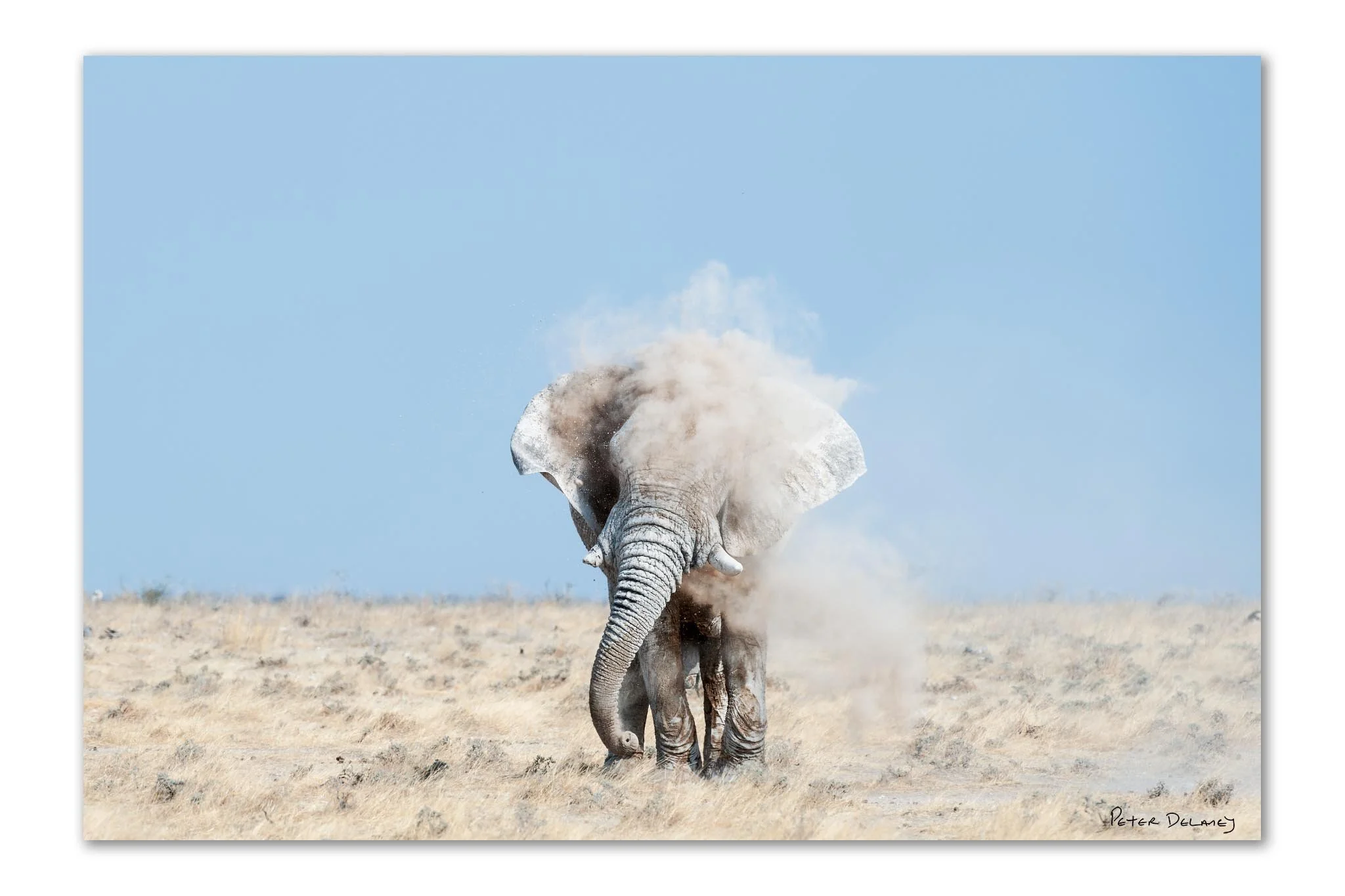
The Godfather | Grey Ghost of Etosha
Shortlisted — Sony World Photo Awards
The Godfather
The almost-monochrome that only colour could hold
He stands in the middle of the veld, eyes half-closed, dozing in the winter afternoon. Around him, the ground is a mixture of sand and chalk, the grass bleached pale yellow by cold nights that sometimes freeze. He is calcrete in colour—that specific, ancient cement-grey that gives the elephants of Etosha their name: the Grey Ghosts.
I call him the Godfather.
It's two in the afternoon. The light is hard, the kind of light you're not supposed to photograph in. But this is winter in Etosha, and the sky does something it only does here: an ice blue. Not cold, exactly. Just pure. The kind of blue you can't describe to someone who hasn't stood under it.
He stands still before me in all his magnificence, raising his trunk filled with the red Kalahari dust. In one fluid movement, he sprays his forehead, and for one brief moment, he is covered in the magic of dust and light.
This image was shortlisted for the Sony World Photo Awards.
Look at it. The palette is almost monochrome—calcrete elephant against bleached winter grass. But that ice blue sky changes everything. Blue and yellow. A primary colour and its perfect companion. The moment you convert to black and white, you lose the conversation between them. You lose the thing that makes this moment specific rather than timeless.
This light, this elephant, this sky—they will never align exactly this way again.
For those who know that some moments are not meant to become timeless—only remembered.
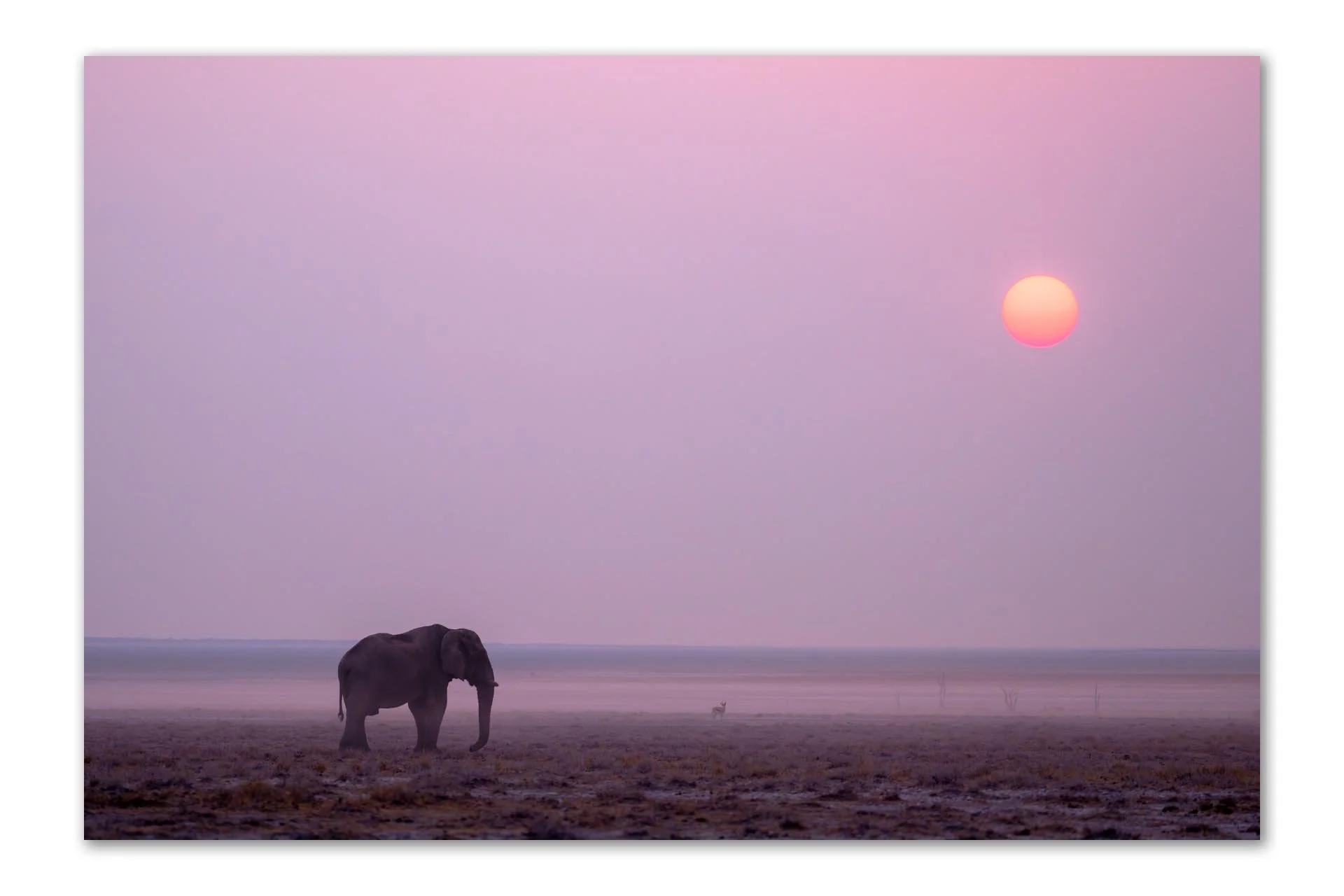
Elephant Velvia Sunset
Etosha at Dusk
Elephant Velvia Sunset
The impossible sky
Winter in Etosha. The sunrises and sunsets are breathtaking. The lower atmosphere is filled with sand and white dust, creating a mesmerising red and orange hue in the sky.
In the evenings, a mist descends and adds to the enchanting atmosphere, giving everything a beautiful ethereal glow. The stillness and quietness of the surrounding environment were so profound that it almost felt deafening.
A Bull Elephant grazes on the edge of Etosha Pan.
Then he stops.
He has stopped grazing and, like me, watches the last rays of the day and Velvia glow wash over us.
I shot this on Fuji Velvia—film stock legendary for its saturation, its ability to make colour sing. The pink sky, the purple haze, the mist, the bull standing in light that shouldn't exist.
Some scenes are so improbable that only colour can make you believe you actually saw them.
For those who have stood in light that felt like grace.
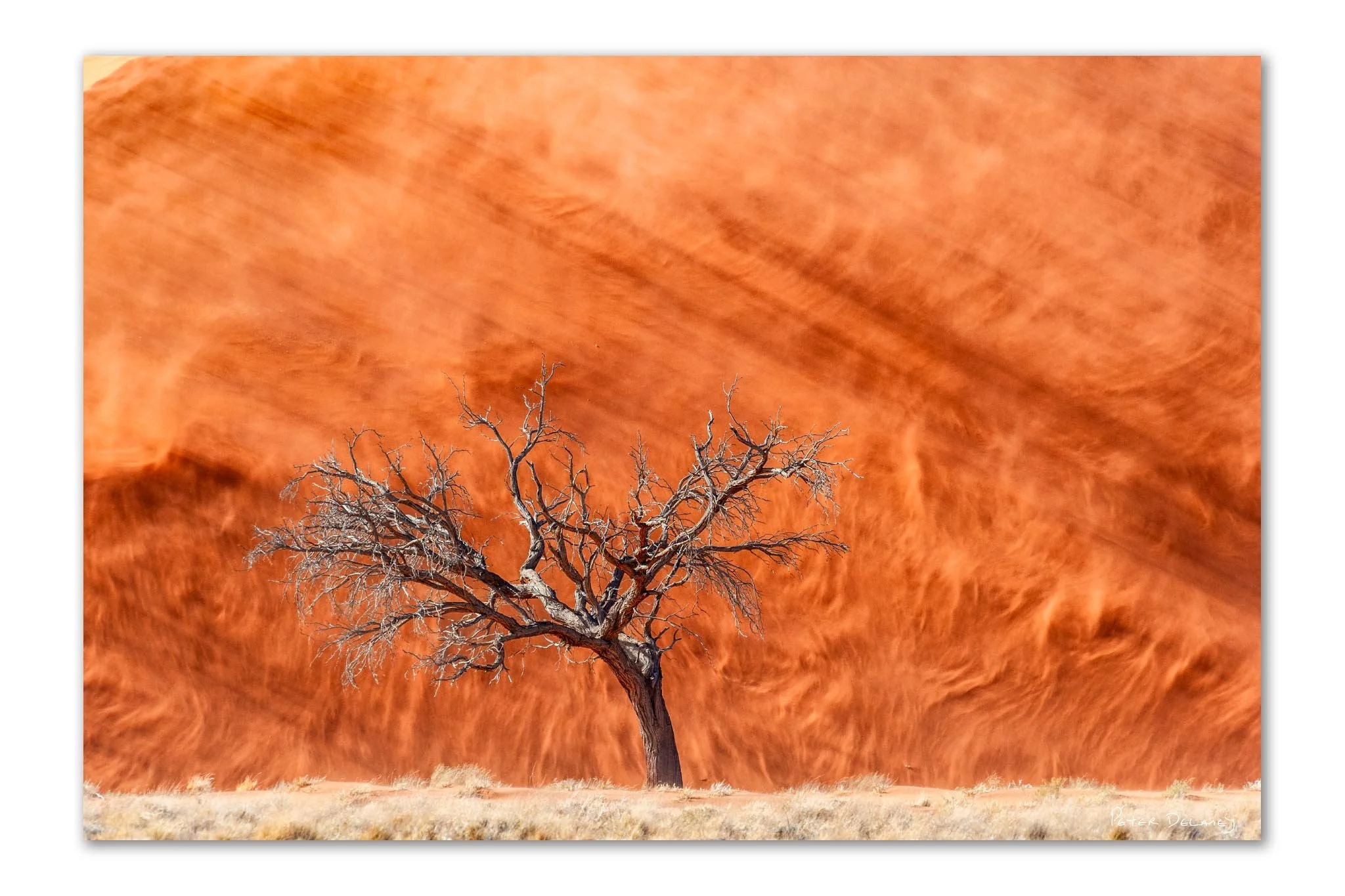
Dune on Fire
Memorial Maria Luisa Competition — Recognised
Dune on Fire
The red that is the storm
Dune 45 is one of the most photographed dunes in the world. Capturing something unique is nearly impossible. The constant flow of visitors climbing from morning to late afternoon, leaves little room for solitude.
Late one afternoon, a sandstorm rolled in. Everyone fled for cover. Suddenly, the desert was empty.
I grabbed my 600mm lens—a choice shaped by years as a wildlife photographer, and who shoots landscape with a 600mm?—and crouched behind my 4x4 as the wind whipped sand through the air. The grains stung my face and eyes. But through the long lens, the dunes transformed.
They became a tapestry. Folds and shadows in shades of red, the late afternoon light carving depth into the sand. And at the base, the camelthorn tree. The most recognised tree in the world, sitting there like it had been waiting for this moment.
That red isn't a metaphor. It's actual. The sandstorm didn't create the conditions for colour—it was the colour. Convert this image to black and white, and you don't lose atmosphere. You lose the event itself.
This photograph was recognised at the Memorial Maria Luisa Competition. But what I'm proudest of is this: I created something unique in a place visited by thousands. The event itself is rare. It cannot be copied.
In my work, composition and timing must go hand in hand. A 600mm lens on a landscape? Nobody does that. But it gave me this—a moment when nature briefly reclaimed itself.
For those who find the divine in places everyone else has left.

Storm Over the Karoo
Mountain Zebra National Park
Storm Over the Karoo
The blue that carries the weather
The Karoo has always held a special place for me. Its vast openness and silence bring a deep sense of calm. Yet on a trip to Mountain Zebra National Park, that stillness was broken by a storm of almost biblical scale.
I had imagined this image for years. Dark clouds building over parched land. Thunder rolling across the plains. Lightning tearing through the sky. But nothing prepares you for witnessing such power firsthand.
It was winter. The grass had burnt yellow beneath that immense sky. Rain is rare in these parts—some areas of the Karoo wait months, sometimes longer. This is a harsh land where only the toughest survive. Storms like this aren't just weather. They are lifeblood. A reprieve from the intense heat of summer, when the earth bakes and the silence feels heavier.
What colour holds here is weight. The dark blues of that sky aren't just aesthetic—they carry the storm itself. The rain that hasn't yet fallen. The relief that hasn't yet arrived. Convert this to black and white and you get drama, yes. But you lose the particular gravity of a sky that is actually that colour.
Black and white would have given me timelessness. I needed you to feel what that storm meant to the land below.
For those who understand that some things arrive just in time.
Why This Matters
People often ask why I work in black and white. The honest answer is that it's the only way I know how to show what I actually felt in those moments. Colour tells you what something looks like. Black and white tells you what it means.
But these five images taught me something harder: when to leave it alone.
The Gladiator needed its yellow. The Godfather needed that ice blue sky to keep him from becoming timeless. Elephant Velvia Sunset needed to be improbable. Dune on Fire needed its red. Storm Over the Karoo needed its blue.
Black and white is my voice.
But colour, sometimes, is the thing I'm listening to.