Why I Only Have Two Colour Elephant Prints
I Am, By Instinct and By Choice, A Black and White Photographer
It isn't a rule I set down one morning and decided to follow. It's simply where I see. Black and white strips away the distraction of colour and forces you to look at what's underneath, the shape of a tusk catching light, the texture of skin that has walked ten thousand kilometers, the weight of an animal that has outlived most of what surrounds it. Colour, for me, usually gets in the way of all that.
And then Etosha, Namibia happened twice.
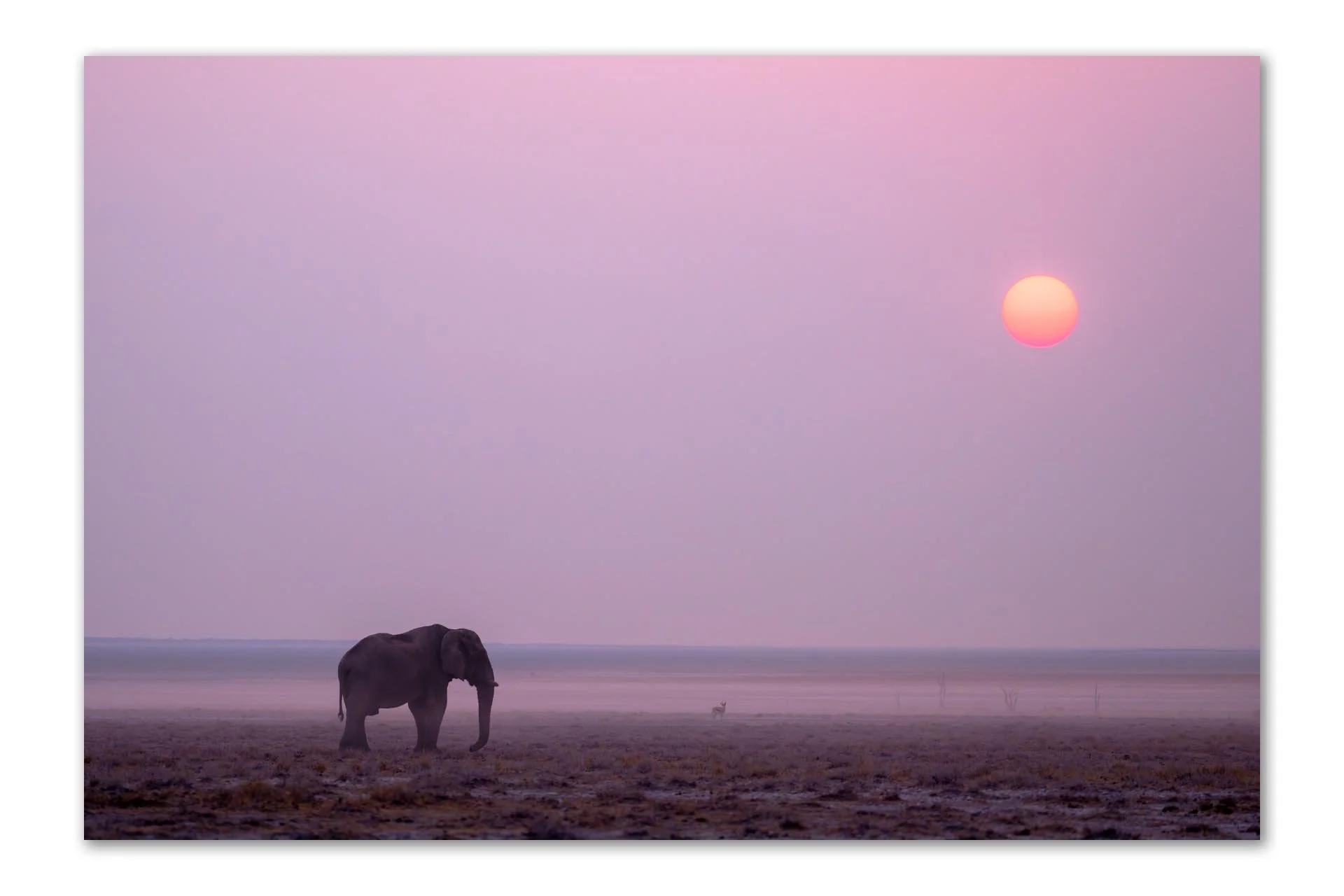
Elephant Velvia Sunset
A purple sky, a red sun, and a bull elephant at the edge of the pan. The evening Etosha broke my rules.
Elephant Velvia Sunset
I was driving back to camp one evening, done for the day, camera packed. The sky over the Etosha pan had been building for an hour — deepening through layers of purple, that particular bruised violet that only comes when late winter dust hangs in the air above the pan. And through it all, the sun was doing what it does in Etosha at that time of year, burning down from yellow to a deep, molten red as it dropped.
I have seen a lot of African sunsets. This one was different.
And then, at the pan's edge, a bull elephant appeared.
He was perfectly silhouetted against that sky. Still. Unhurried. Grazing as if the spectacle above him was simply weather. I pulled over, set up quickly, and made the photograph before the light collapsed.
I called it Elephant Velvia Sunset — Velvia being the old Fujifilm slide film that photographers once loaded specifically to chase colour like this. The name felt right. That photograph was not planned. It arrived, the way the best ones do, as a gift.
I kept it in colour because there was no other honest choice. To convert that sky to black and white would have been to lie about what I saw.
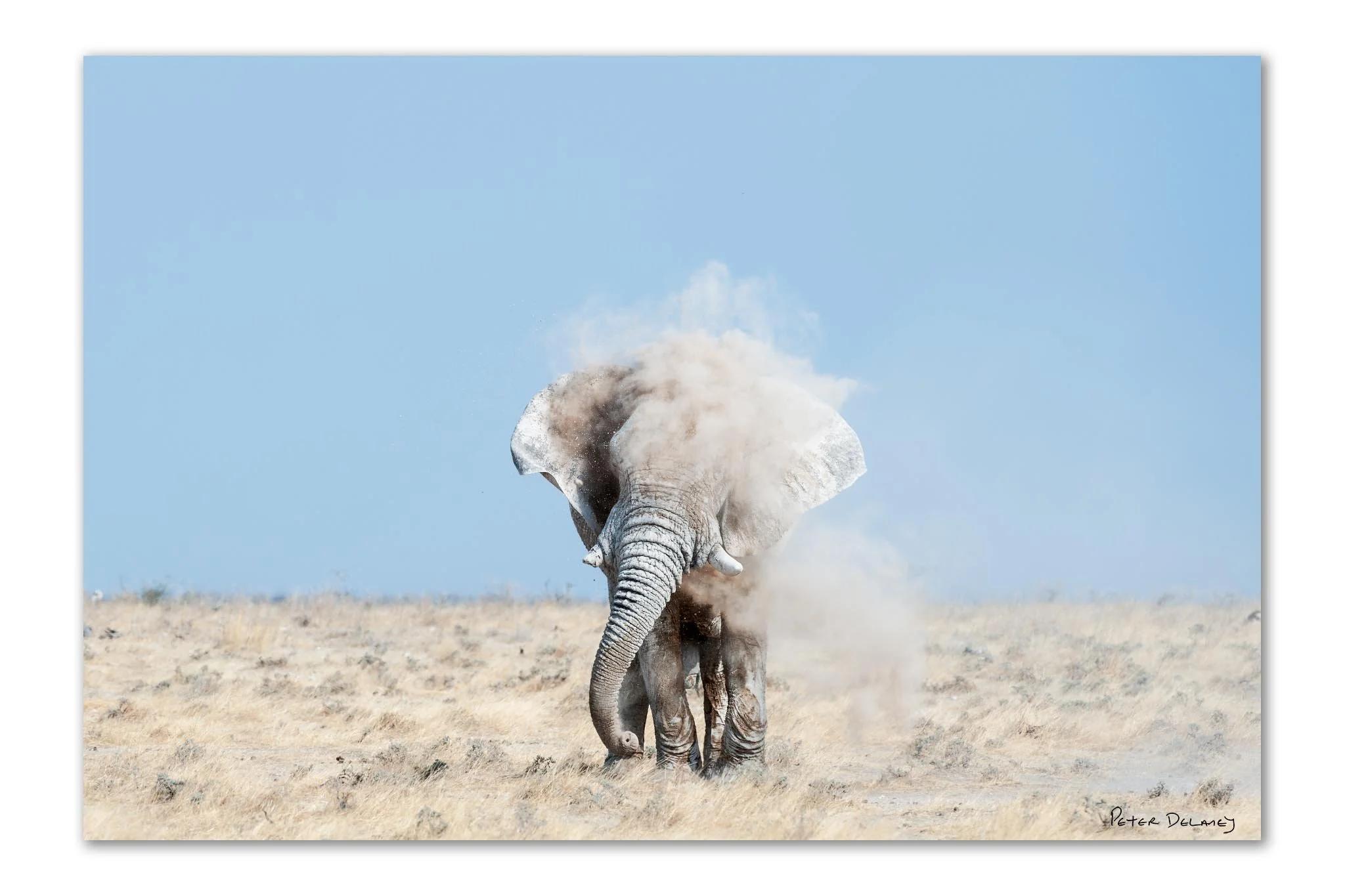
The Godfather
Four tons of authority. Weeks of patience. One moment of red Kalahari dust and light.
The Godfather
The Godfather was the opposite of serendipity.
For weeks, I had been watching a bull elephant I came to call the Godfather — four metres tall, over four tons, the undisputed authority of a waterhole that served as the only water source for twenty square kilometres. Every afternoon he arrived with two shadow bulls at his flanks, and together the Trinity commandeered the water. Springbok, gemsbok, zebra, ostrich, giraffe, even lion — all of them waited at a respectful distance until the elephants decided they were done.
From a photographer's point of view, the waiting was extraordinary in itself. Attempted lion kills. Jousts between young males. A black rhino appearing at the edge of the light like a spectre. But I was waiting for something specific.
Every evening, when the Trinity finally left the waterhole, they walked away from me. Same direction, every time. And every evening I felt the photograph I had been visualising, the one I had run through in my mind a hundred times, slip away with them.
Then one morning I found them feeding somewhere different. Away from their usual ground. I read the change, left early, positioned myself where I thought they would walk, and waited.
The next ten minutes I can only describe as the bliss of forgetfulness. Everything narrowed to the task. And then there was one moment.
He stopped in front of me. Raised his trunk, filled with red Kalahari dust. And in one fluid movement, sprayed his forehead — and for a brief second he was covered in dust and light and something I can only call presence.
I kept that photograph in colour because the red Kalahari dust demanded it. Convert it to black and white and you lose the thing that makes the photograph what it is.
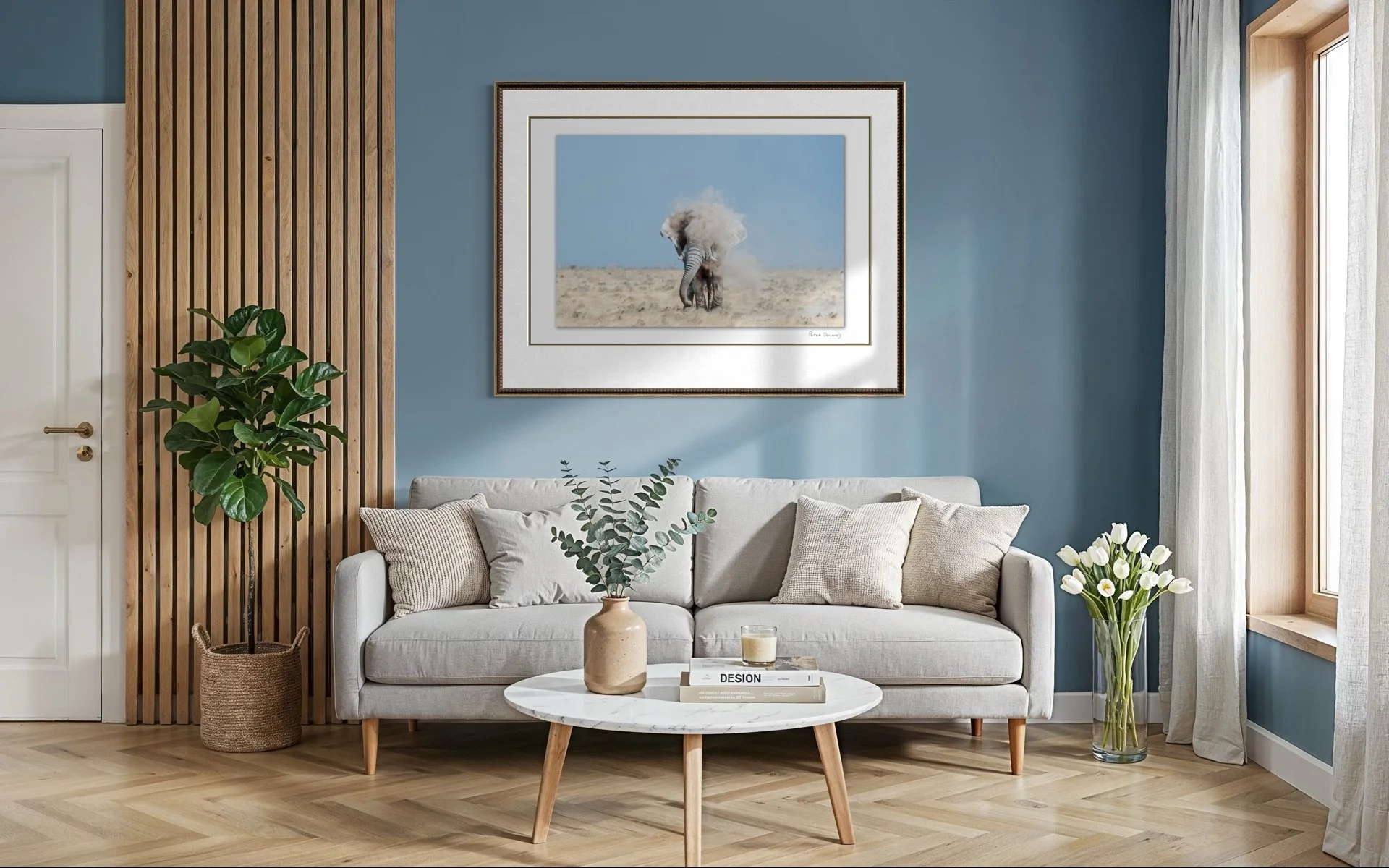
Collector's Edition
Printed by hand · Signed by Peter · Shipped from my South Africa studio
Two Exceptions. Twenty Years. Etosha Both Times.
I don't expect a third. But I've learned not to say never — not in a place that has a habit of proving you wrong.
Both prints are available as acrylic glass, archival unframed, and canvas. If you'd like to know more about either photograph, or discuss sizes and finishes, feel free to get in touch.