Why Do I Only Have Two Leopard Prints?
Why Do I Only Have Two Leopard Prints?
I have been photographing Africa's wildlife for over twenty years. In that time I have had more leopard encounters than I can count, and almost none of them amounted to anything.
A flicker of gold in the grass. A tail disappearing into a thicket. Eyes in the dark and then nothing. The leopard is not like the lion, who tolerates your presence with indifference, or the elephant, who makes herself known from a kilometre away. The leopard decides when and whether you see her. Most of the time, she decides against it.
Of all the large predators in Africa, the leopard is the one that has humbled me most consistently.
Which is why I have two leopard prints in my collection. Not twenty. Two. And both of them took everything I had.
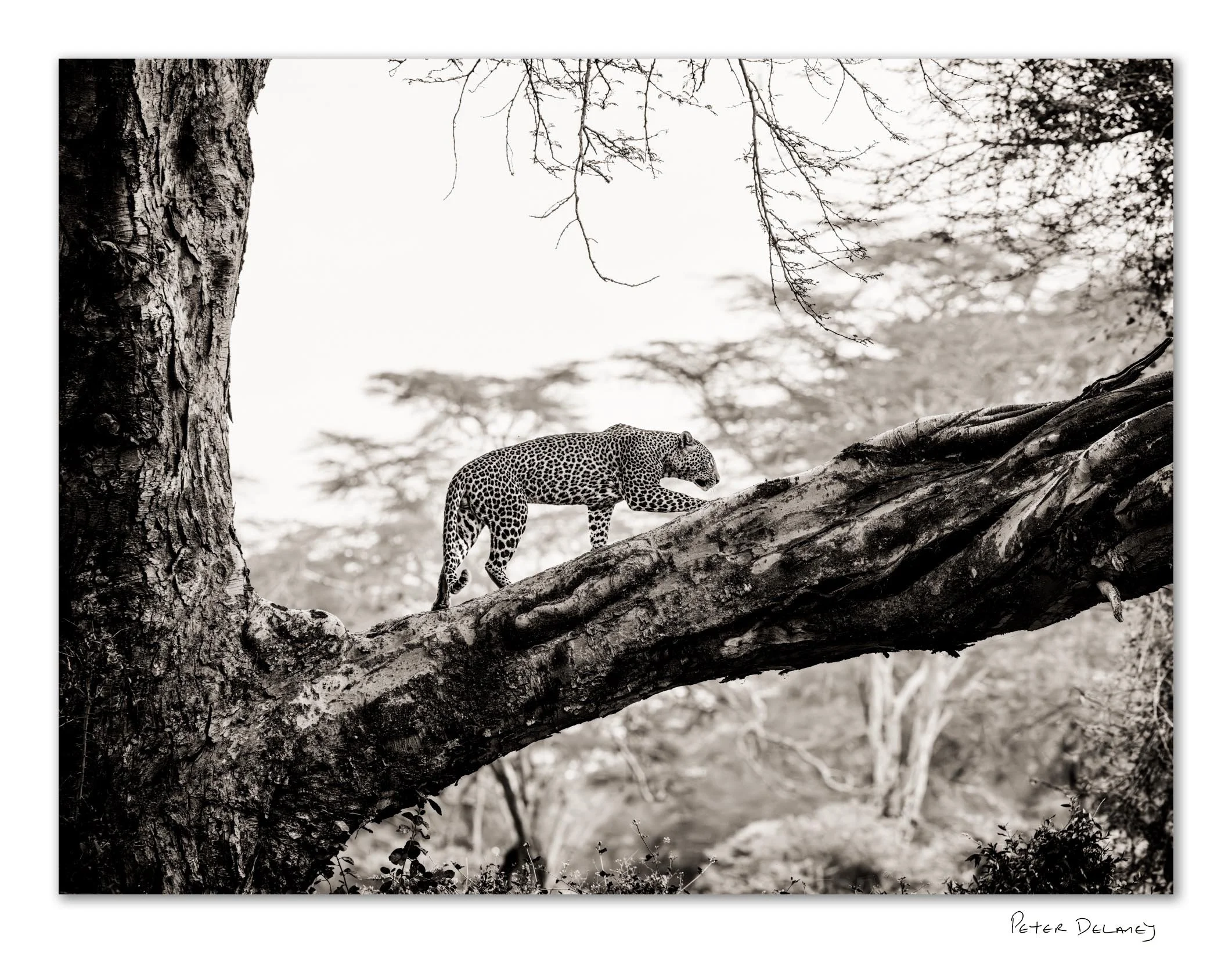
Fever Tree Leopard | Sonly World Photo Awards 2025
Why Two and Not More
There is a particular kind of leopard photograph that the internet has made familiar, a cat draped over a branch, eyes half-closed, tail dangling. Passive. Decorative. The leopard reduced to furniture.
That photograph is not what I am looking for. I am looking for the animal in motion, alert, purposeful, alive in the way that only a predator moving through its own territory can be. That moment is rare. The leopard is nocturnal by nature, most active in darkness, and during daylight hours, she sleeps in deep cover where no lens can find her.
To find her active, in a tree, in good light, at an angle that does justice to the animal, that is not something you plan. It is something you earn through days of tracking, through patience that borders on stubbornness, through the willingness to keep moving when every instinct says stop.
I have earned it twice.

Salayexe
Stealth. A legendary leopard moving through the Sabi Sands shadows
Salayexe — Sabi Sands, 2009
The first time was in the Sabi Sands, in the Greater Kruger. I was still learning my craft, that matters, because what happened that morning was more luck than skill, and I have always been honest about that.
We had been tracking Salayexe for hours across difficult ground, losing her repeatedly, trying to predict her movements, repositioning, waiting. When she finally appeared in the Marula tree, I had one decision to make quickly: where to place myself.
There was a slope beside the tree. I used it. It gave me a slight elevation that changed everything. Instead of shooting steeply upwards and losing the subject against the sky, I had a gentle upward angle that kept her in context, the great Marula framing her without dominating. She walked the branch. For one moment, her paw lifted, a subtle suggestion of motion while her head remained sharp and focused.
I made the photograph. It became Salayexe, Leopard on the Prowl.
She died in 2017. Born in 2005, the daughter of Saseka and sired by the formidable Mufufunyane, she spent her life ruling the territory around Elephant Plains. Her cubs, Nsele, Rhulani, and Tiyani, carried her line forward. When you look at this photograph now, you are looking at an animal that no longer exists. That weight is part of what the print carries.
This rare footage, captured just days before Salayexe's passing, shows her in her prime—a powerful, living testament to her enduring spirit.
Fever Tree Leopard — Lake Nakuru, Kenya
The second time was different in almost every way, different country, different tree, different light, different outcome.
Lake Nakuru. I had come for giraffes. The wild had other plans.
We tracked her through the fever tree forest for a long time, losing her and finding her again, the yellow-barked trees throwing strange dappled light across everything. When she settled into the bough of a massive fever tree, the branch so large and low it was almost a platform, we positioned the vehicle alongside it, and I came up through the sunroof.
That elevation was everything. Eye level with the branch, not looking up at it. The perspective became intimate rather than reverential; you are with her, not beneath her.
She rested for a long time. Then, for no reason I could identify, she stood. Walked the length of the branch toward the trunk. I thought she was coming down. She didn't. She turned. Her tail swept a long, fluid arc behind her.
Low light. High ISO. The fever trees behind her were fading into soft focus, their yellow forms becoming a forest rather than a background. I made one frame.
That photograph became Fever Tree Leopard — now a limited edition of eleven prints.
Fever Tree Leopard | Limited Edition
Elegance. A leopard turning through dappled light, tail lifted and coiled in motion.
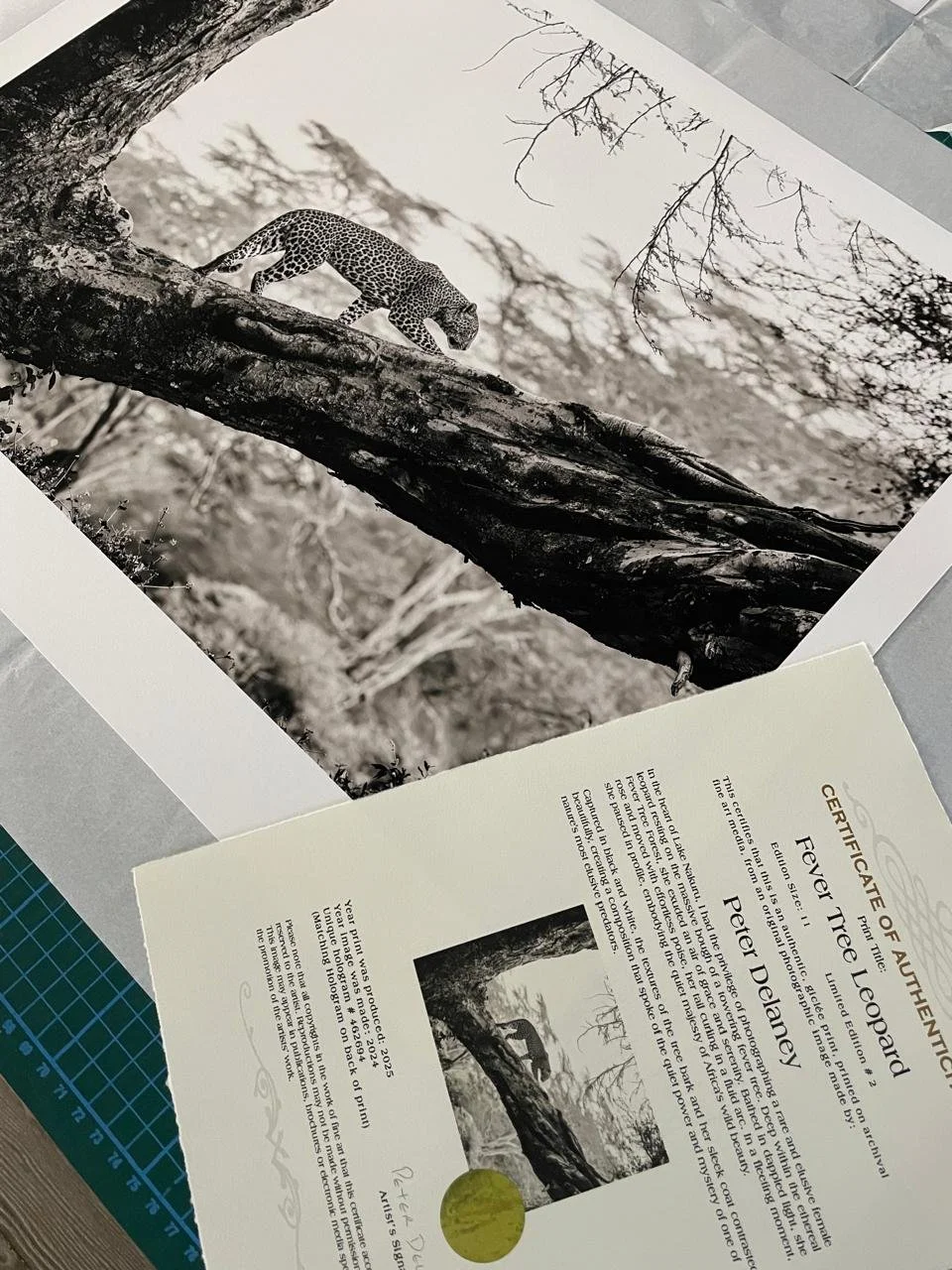
Printed on Hahnemuhle Photo Rag
Certificate of authenticity for the Fever Tree Leopard limited edition fine art print,
A brief moment from Lake Nakuru, watch the leopard move through the fever tree forest that inspired this limited edition print.
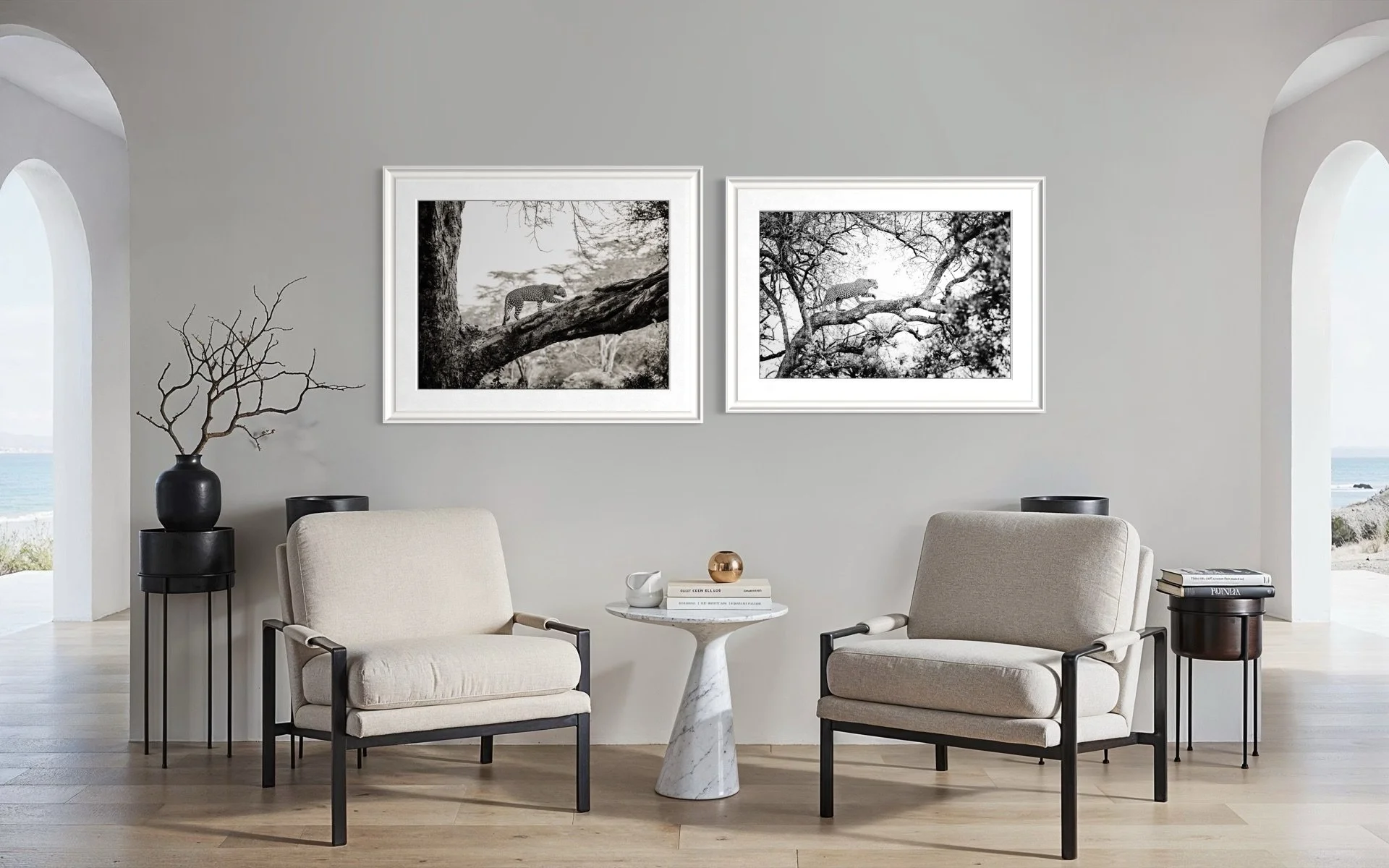
Two framed prints. One standard. Earned twice.
What These Two Photographs Have in Common
Both were made from an elevated position that changed the geometry of the shot. Both required tracking across the ground, losing the animal and finding her again. Both captured movement, not the static, sleeping leopard that fills social media, but an animal doing something, going somewhere, alive in the frame.
And both required me to stop trying to force the photograph and simply be ready when it happened.
The leopard teaches you that faster than any other animal. You cannot pursue her. You can only prepare, position, and wait, and when the moment comes, trust what you have learned enough to act without thinking.
Twenty years in, two photographs. I am still waiting for the third.
The Prints
Salayexe — Leopard on the Prowl
An animal that no longer exists, preserved in a single frame. Available as a fine art print in unframed and acrylic formats. Open edition.
View Salayexe — Leopard on the Prowl →
Fever Tree Leopard
One frame. One chance. A limited edition of eleven prints, each hand-signed, numbered, and registered with Hahnemühle's My Art Registry. Available in unframed and acrylic formats.
Each photograph is archival black and white, printed to museum standards. Free worldwide shipping.