Seeing in Black and White — A Wildlife Photographer's Eye
I didn't set out to be a black and white photographer. It found me the way most things that matter do — slowly, then all at once.
In a bookshop in London, somewhere in the mid-nineties, I picked up a book of Don McCullin's work. I stood there for twenty minutes. Not because of the subject matter. Because of what he had done with light and shadow — the way absence of colour made everything feel more true, not less. I bought the book, took it home, and something shifted.
That was the beginning.
What colour takes away — and what that gives you
We are trained to see colour as information. Red means danger. Blue means calm. Green means life. When you remove it, the viewer has to work differently. They look at form. At texture. At the quality of light on skin, on fur, on the surface of water.
Africa is the right continent for this.
The light here is extraordinary — hard and directional in the dry season, softer and more diffuse after rain. An elephant's hide in morning light is a landscape in itself: ridges and valleys, shadow pools, the map of a life lived outdoors. In colour, you see a grey elephant. In black and white, you see time.
The same is true of a lion's gaze, or the coiled patience of a leopard on a branch. Colour tells you what something looks like. Black and white tells you what it is.

Heart of Darkness
Focus. A tight portrait of a lion’s gaze, still and absolute in its intensity.
Heart of Darkness
I photographed this Kalahari black-maned lion in the Kgalagadi. He had murder on his mind.
A few minutes before I made this photograph, I watched a lioness and her cubs run towards me and past me, close enough that I could hear their breathing. They didn't look back. It wasn't until the male came into view that I understood why they were moving so fast.
I followed him as far as I could, watching him work, methodical, unhurried, certain of the outcome. The photograph I made that morning captures something in his eyes that I cannot adequately describe in words. That is why I made it in black and white.
Some things are too raw for colour.

Big Foot
Weight. A close study of an elephant's foot — ancient, unhurried, and vast beyond expectation.
Big Foot
This photograph won Wildlife Photographer of the Year 2011 in the Nature in Black and White category. It was made at Mapungubwe Game Reserve on a cold morning with no coffee and a 600mm lens, the wrong lens for the situation, most photographers would say.
When the herd came within twenty metres, I made a different calculation. I stopped trying to make the photograph I had planned and started making the photograph that was possible. I moved down the animal, tusks, eyes, ears, until I reached the foot.
The wrinkles. The weight. The sheer improbable scale of something that walks across the earth so quietly.
I think about that situation when I'm tempted to force a photograph. Sometimes the limitation is the photograph.

Contemplation
Emotion. A moment of thought, held in stillness.
Contemplation
Kibale National Park, Uganda. Hours of trekking through dense rainforest for glimpses of chimpanzees high in the canopy. Time running out.
Then they came down, a cascade of them, moving fast, beginning what looked like a hunt. It ended as suddenly as it started, and the forest went quiet.
I asked for permission to move off on my own. I sat on a fallen log and waited.
Totti came out of the trees slowly, an alpha male, and settled near me. He lay on his back, a posture I had not seen before, and stared upward at a female far above. Whatever he was feeling, it was familiar. Desire. Resignation. Something in between.
I made one frame. It became Contemplation, and it won the Animal Portraits category at Wildlife Photographer of the Year 2017.
In colour, he would have been a chimpanzee. In black and white, he was something else entirely.
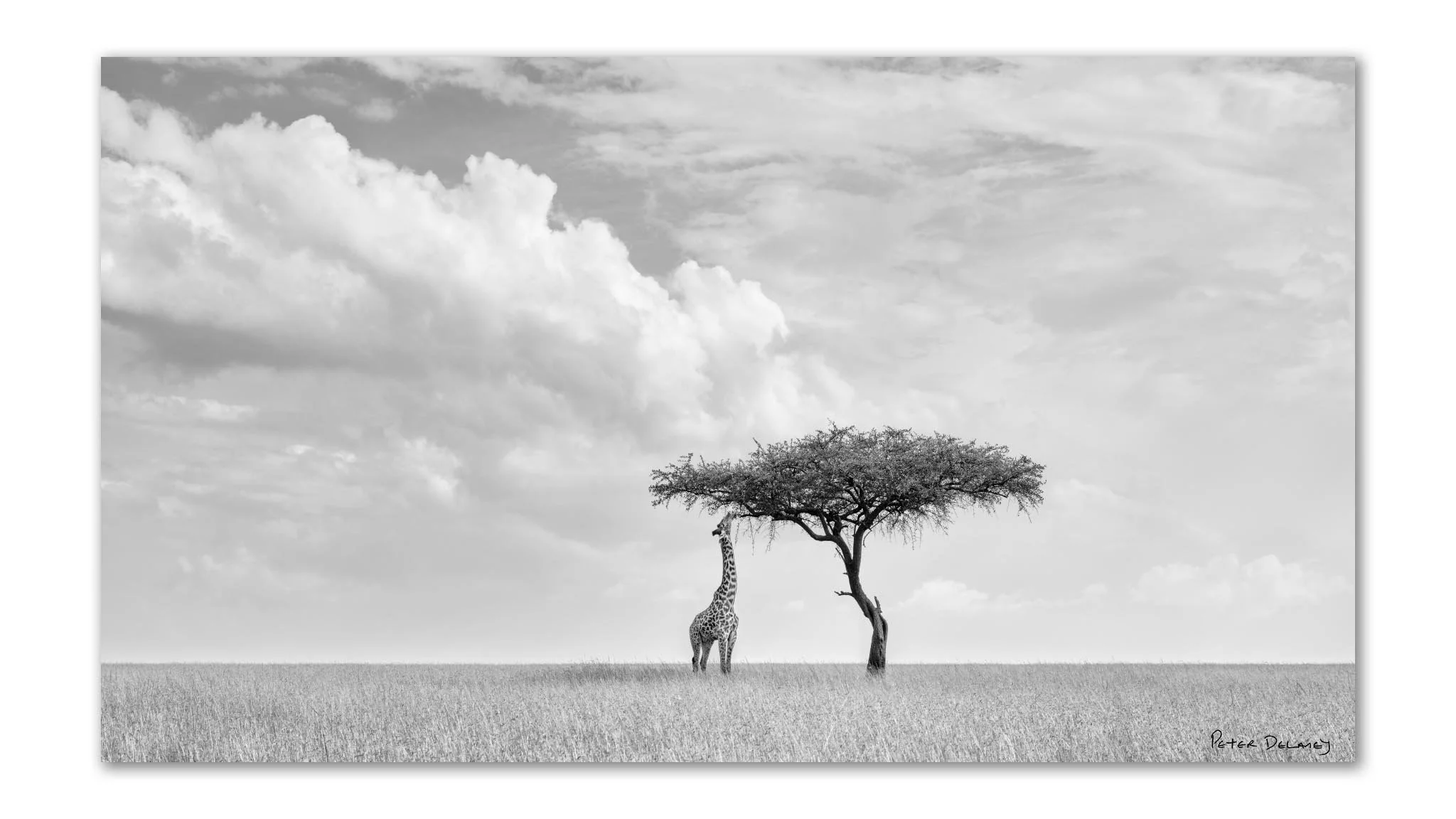
Camelopard
Solitude. A lone giraffe beneath the acacia after the storm.
Camelopard
This is the kind of photograph I could not have made earlier in my career. Not because the opportunity wasn't there — but because I wouldn't have seen it.
A single giraffe. Space. Silence after rain. Nothing happening, and everything.
How I work
I don't lift my camera unless I feel something. Not a technical calculation, a physical sensation. A flutter. A pull. Something that says there is something here, go towards it.
That feeling is the beginning of every photograph I have ever made that matters.
In the field, I am aware of everything light, perspective, scale, what I include, what I exclude, the shape and form in front of me, but I am not running through a checklist. I am feeling my way. The same is true in the edit. I have no fixed process, no pre-visualisation, no rules I follow from one print to the next. I follow the feeling until the photograph tells me it's done.
As my work has grown, it has become simpler. One camera, one lens, most of the time. Less in the frame, not more. I am drawn now to space, to quiet, to scale, to the kind of stillness that asks the viewer to slow down and stay a while. There is a state I enter in the field, and sometimes in the darkroom too, that is close to peace. Alert, but calm. Aware of everything, attached to nothing.
The work that comes from that state is, I think, the best I make.
But I am not only instinct. Structure matters. Light, composition, tonal balance, these are the bones beneath the feeling. The prints I am most proud of hold both in equal measure: half heart, half head. Enough craft that they stand up to scrutiny. Enough feeling that scrutiny is beside the point.
Africa gives you the subjects. Everything else, you bring yourself.