Some wildlife prints fill a wall. Others hold it.
This is the difference.
A guide for understanding museum-grade African wildlife prints.
A fine art print is not décor.
Décor is chosen to match a room. When the room changes, it goes.
A fine art print is chosen because it cannot be replaced. The moment it holds happened once, in one place, under one light. It will not happen again.
Craig beneath Kilimanjaro. Nkuma in the Shingwedzi riverbed. Two giraffes rising in unison on the edge of Etosha.
Not a photograph. A record.
Craig. Amboseli. 1972–2026.
A fine art print is not mass-produced.
Most wildlife prints are made for volume. Unlimited runs, standard materials, designed to look good online.
At scale, in real light, they fall away.
A fine art print is made to hold. Printed on archival Hahnemühle Photo Rag, 100% cotton, museum-grade matte paper. Produced by specialist printers. Built for depth, detail, and permanence.
The difference is immediate.
“Black and white is not a style choice.
Colour is everywhere.
Black and white removes distraction. What remains is form, light, texture, presence.
Either the photograph stands on its own, or it does not.
Colour is recorded. Black and white is felt.”

The Matriach
What I make.
Every photograph is made in the field, over the years, with specific animals in specific places, Amboseli, Etosha, Kruger, the Mara, Addo.
These are not stock photographs. They are portraits of individuals. Craig. Salayexe. Ruka and Rafiki. Nkuma.
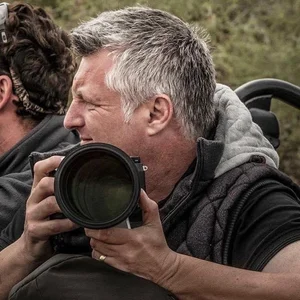
Work built on proximity, patience, and return. Shot on a Fujifilm GFX 100, 100 megapixel medium format, the resolution that holds at any scale.
Three formats. One standard.
Archival Hahnemühle loose prints, museum-grade matte, 100% cotton
Acrylic glass prints, face-mounted on 2mm crystal-clear acrylic
Canvas prints, hand-stretched on solid wood stretcher, optional floating frame in black oak, brown elder, natural, or white maple
Available in sizes from collector scale to monumental works up to 290 cm, 114 inches.
Every piece produced to archival fine art quality
Free worldwide shipping, insured and trackable
Ruka & Rafiki
The question worth asking
Will this look better in five years than it does today
Will it still hold the wall in twenty
If the answer is yes, it belongs there