Delaney's Journal: Stories from the Wild
Step behind the lens and into the narrative of each photograph.
Discover the rare moments, raw emotion, and artistic vision that define these timeless black and white artworks.
Black-Maned Lions: Africa Big Cat Portraits in Black and White
There is a moment every photographer knows — when you stop thinking about the camera. Because something is looking at you, and every instinct goes quiet. Not from calm. From something older than calm. That is the lion. This is the story of Norman, Caesar, Kijani, the Serengeti Boys — and what it means to be seen.
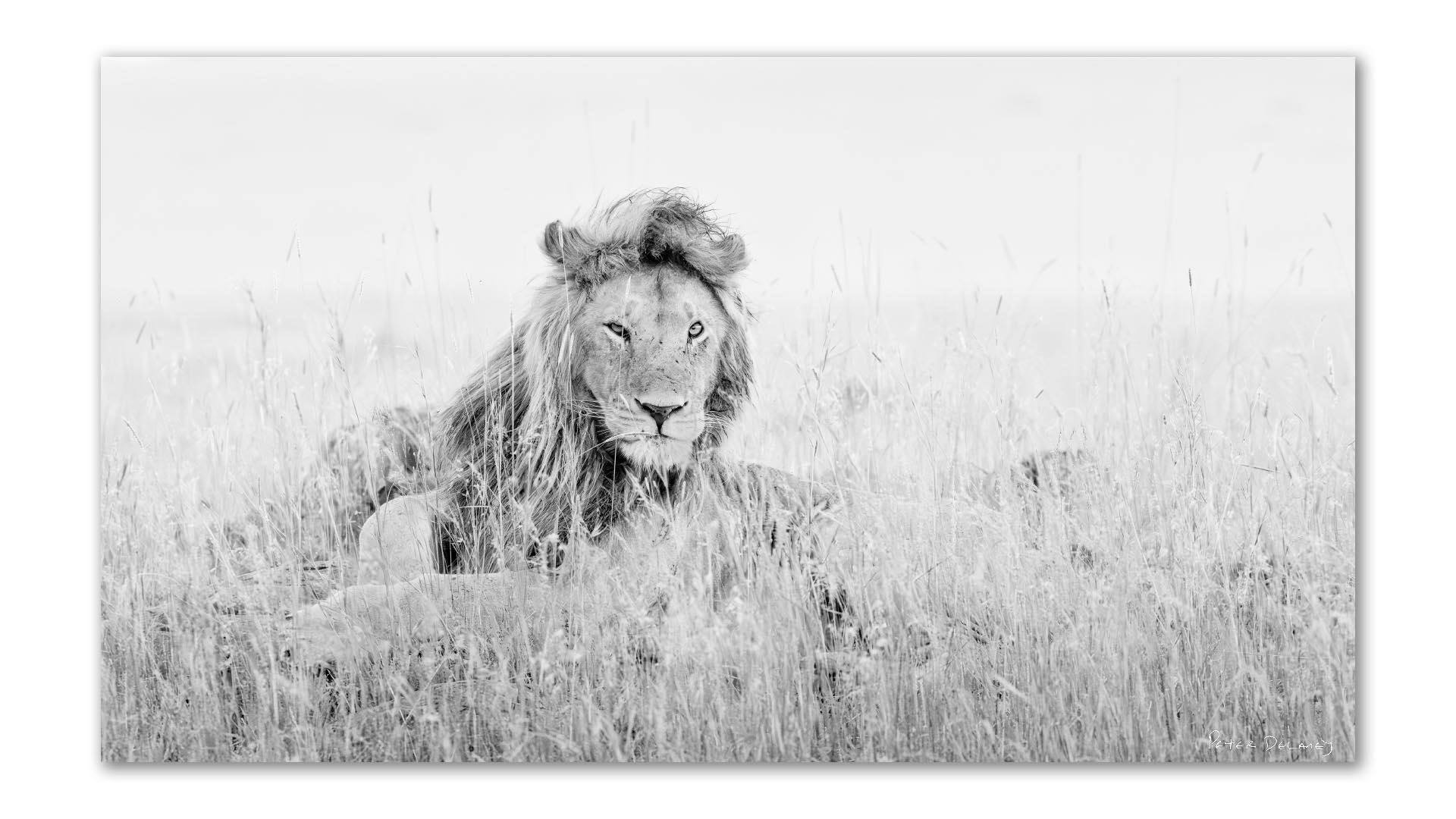
Eye to Eye | Serengeti Boy | Mara North Conservancy, Kenya
Startled from rain-soaked grass — one blade across his face, one eye half-closed, and a stare that stops time
There is a moment — and every photographer who has spent serious time in Africa knows it — when you stop thinking about the camera.
The exposure, the composition, the light — all of it falls away. Because something is looking at you, and every instinct you have goes quiet. Not from calm. From something older than calm.
That is the lion.
Not the lion of documentaries or zoo enclosures or children's books. The real one. The one whose eyes carry no curiosity about you — only assessment. The one whose silence is not peace but potential. The one our ancestors built walls and fires and entire mythologies to keep at a distance.
I have spent twenty years in Africa. I have sat with elephants in the blue hour before dawn, watched leopards dissolve into trees, followed cheetah brothers across open plains. But nothing — nothing — stops time the way a black-maned lion does when he decides to look at you.
This collection is about that moment. What it means to be seen.
Norman | Black-Maned Lion | Tswalu, Kalahari
From fierce rivals to unbreakable allies — the Kalahari titan who ruled vast territories
Norman & Zwaai — Tswalu, The Kalahari
The Kalahari is a different Africa.
Hotter. Drier. More ancient somehow — as if the land itself remembers something the rest of the continent has forgotten. The red dunes, the silver-grey camelthorn, the silence that has weight to it. And moving through all of it, the black-maned lions of Tswalu — a subspecies apart, built larger and darker than their savannah cousins, shaped by an environment that does not forgive weakness.
Norman and Zwaai were fierce rivals before they became something rarer: allies. From the blood of that rivalry came a coalition that ruled vast Kalahari territories. To stand near them was to understand what the word "dominant" actually means. Not aggression. Not noise. Just a presence so complete that everything else in the landscape reorganises itself around it.
Norman's portrait captures it precisely — the battle-scarred face, the black mane so dark it seems to absorb the light around it, the eyes that hold yours without blinking and without hurry. He is not threatening you. He simply does not need to.
His story is a testament to resilience and unity — from fierce rivals to unbreakable allies. The Kalahari made them. This image preserves them.
Caesar | Black-Maned Lion | Kalahari Portrait
Power incarnate — a battle-scarred face that has seen everything and forgotten nothing
Caesar & Cassius — Marataba, North West
At Marataba, during a photographic safari with clients, I found myself in the presence of a coalition that had ruled their pride for years.
Caesar and Cassius were born at this reserve. They had hunted together, fought together, held territory together through countless seasons. When we located them, they had just finished a zebra kill — and in the unhurried way of lions who know exactly where they stand in the world, they moved off toward a nearby waterhole to drink.
We followed. For an hour, I sat with two of the largest animals I have ever been close to, watching moments that almost no one witnesses in the open. A cub arrived. Cassius — massive, dark-maned, monumental — settled into a pose of absolute regal calm while the cub stood before him. Caesar watched. The dust settled.
Legacy of the Kings and Heir to the Throne were made in those quiet minutes. Caesar and Cassius are no longer with us. But their spirit — the specific weight of their presence, the particular way power can also be gentle — is preserved in these prints forever.
Legacy of the Kings | Caesar & Cassius | Marataba
Two Kalahari black-maned lions at rest — a coalition that ruled for years
Heir to the Throne | Caesar & Cub | Marataba
A young cub stands fearless before the ruling black-maned titan
Heart of Darkness | Kalahari Black-Maned Lion
When predatory eyes lock with yours, no amount of experience removes the chill
Heart of Darkness — The Kalahari
I want to be honest about something.
When you are alone, a few metres from a Kalahari black-maned lion on the move, and his eyes lock with yours — you feel something that no amount of experience entirely removes. Something cold and old and entirely honest. Our forefathers built their kraals from this feeling. They sang songs about it. They passed it down through generations.
It is not irrational. It is correct.
The lion in Heart of Darkness had murder on his mind. I had been watching a lioness and cubs move past me at speed — nervous, urgent, not understanding what they were running from. Moments later, he came into view. A Kalahari male, tracking them with the cold precision of something that has never needed to hurry.
I followed as far as I could, photographing him as he walked. The image captures his predatory gaze — not rage, not drama, just absolute focus. The kind that makes you understand, very quietly, why Africa built so many stories around these animals.
Hang this print and feel what those ancestors felt. It is not comfortable. It is true.
The Stare | Young Lion | Lake Nakuru
As sunlight faded, two worlds collided — and neither looked away first
The Stare— Lake Nakuru, Kenya
As the golden light of sunset faded over Lake Nakuru, a young male rose from the dust of the road where his pride lay sprawled. He didn't stretch. He didn't look away. He simply turned and looked — directly, completely, without the slightest awareness that this should feel extraordinary.
But it did.
There is no barrier in this image. No distance. No safe remove between you and what is looking at you. His frame is powerful, his gaze is steady, and the fire in his eyes is not aggression — it is simply the absolute confidence of something that has never needed to be afraid.
The Stare was made in that moment. It is not a photograph of a lion at sunset. It is the moment two worlds collided — and neither looked away first.
Kijani — Warrior, Heir | Young Lion Portrait
The solitary burden of the protector — a crown not yet claimed
Sentinel of the Pride | Panoramic Portrait
Battles fought, kingdoms yet to come — the silent duty of a future king
Kijani — Warrior, Heir
We had been waiting nearly an hour for the pride to move.
The late afternoon sun was soft. The lions lay in the dust of the road — sleeping, heavy, entirely unbothered by us. I watched them, hoping.
Then he woke.
A young male — massive for his age, scars fresh on his flank, mane beginning to come in thick and dark. He rose not with a start but with a slow, deliberate power that changed the air. He didn't look at me. He stood, side-on, profile perfect, gaze fixed on something beyond the frame — a horizon only he could read.
The pride slept on while Kijani stood watch. That is the image: the solitary burden of the protector, the weight of a crown not yet claimed. He was listening. Sensing. Already becoming what he would be.
There is something in Kijani that speaks to a particular kind of person — those who understand that the most important things are done quietly, while everyone else is asleep.
Scarred and Unbowed | Mara Coalition Lion
his scars are not wounds anymore — they are records
Scarred and Unbowed — Weathering the Tempest
Not every lion portrait is about stillness.
Scarred and Unbowed is about what endurance looks like in a body — the rain-soaked mane clinging to a frame carved by conflict, the scars that are not wounds anymore but records. A coalition lion on storm-swept plains, resolute. He is not posturing. He is simply present, the way only those who have survived everything can be.
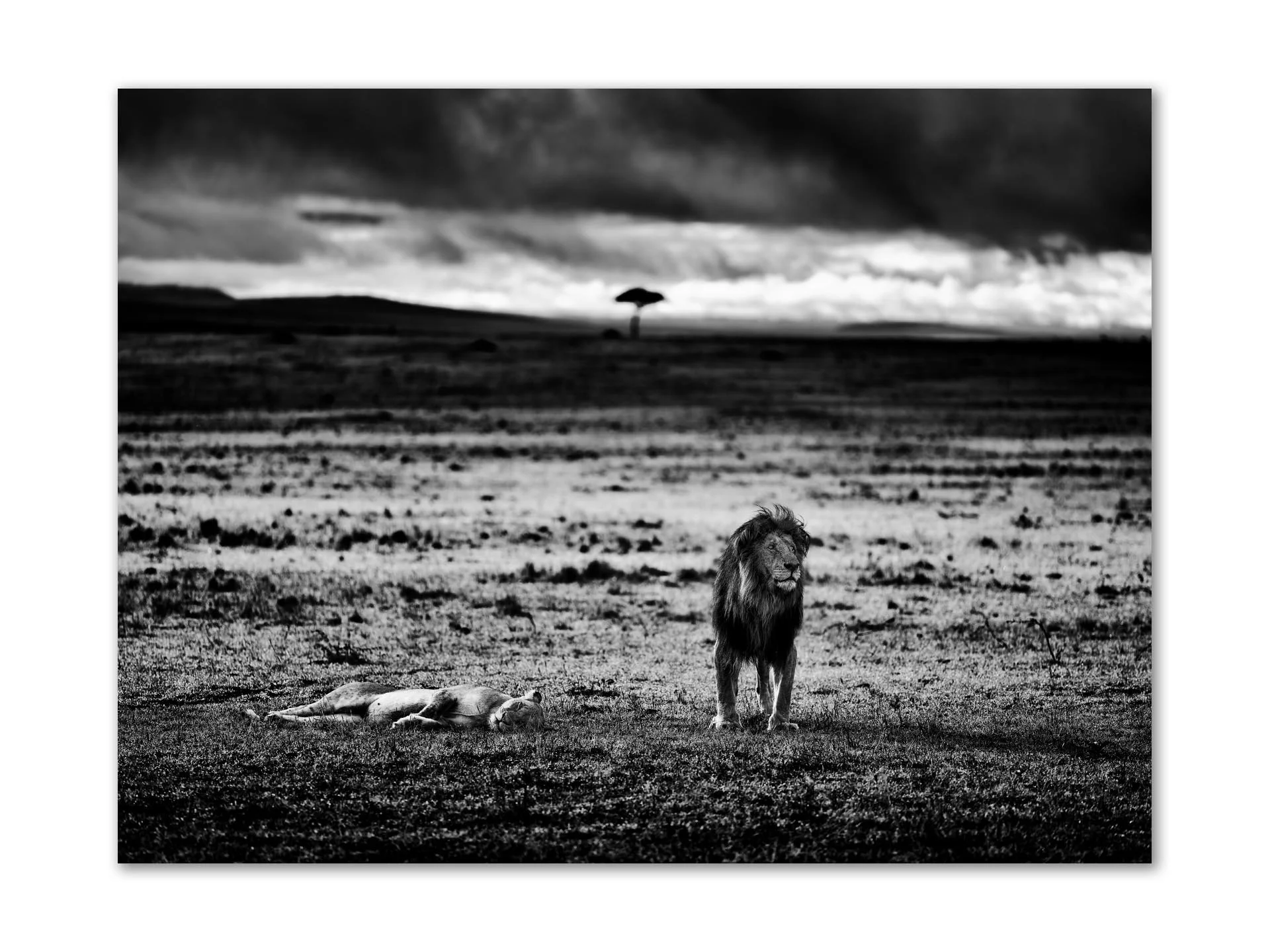
Weathering the Tempest is its counterpart — a lion and lioness on the vast Mara under a bruised, electric sky. He looks outward, asking a question. She looks at you, perfectly still, asking another. I chose a wider lens than usual to keep the savannah in frame — the hills, the lone tree, the storm — because the land is part of this story. It always is.
In the digital darkroom, I use tonal range the way a painter uses shadow — to walk the viewer through the frame, to make sure every element earns its place. These are not photographs of lions. They are photographs of what it feels like to be in the presence of something ancient and alive.
Weathering the Tempest | Lion & Lioness | Masai Mara
He looks outward. She looks at you. The storm builds behind them both.
About These Prints
The lion collection is available as crystal acrylic face-mounted prints, archival canvas on solid wood stretcher frames, and unframed Hahnemühle Photo Rag fine art prints — the gold standard for museum-grade output.
Every format is available in a full range of sizes, from intimate to monumental.
All prints ship free, worldwide, fully insured, in premium protective packaging.
Norman. Caesar. Kijani. Eye to Eye. Heart of Darkness.
These are not decorations. They are confrontations.
How Black & White Photography Reveals the Soul of African Wildlife
Award-winning photographer Peter Delaney explores the emotional power of monochrome. Discover the stories behind the lens and learn how stripping away color reveals the raw texture, emotion, and timeless soul of Africa's majestic wildlife.
Seeing in Monochrome
It was on a solitary lunch break, escaping the relentless hum of London's financial district, that I first truly understood the power of monochrome. In the quiet, dusty confines of a second-hand bookshop, I stumbled upon a copy of Don McCullin's “Retrospective”.
As I turned the pages, his portraits of raw, human truth—not of war, but of soul—seared themselves into my mind. In that city of numbers and noise, his images were a silent, devastating shock.
They spoke in a language deeper than colour, a dialect of light, shadow, and gut-wrenching emotion.\
In that moment, a seed was planted. From that day forward, I didn't just see in black and white; I began to feel the world through its stark, honest contrast.
Weathering the Tempest
"Bring a touch of the wild into your space.
A Lesson in Seeing: Weathering the Tempest
This philosophy was put to the test with “Lions - Weathering the Tempest.”
We happened upon this lion and lioness in the heart of the Masai Mara, and my body went into overdrive. The heart-pounding euphoria told me this was a moment to translate into art.
But raw emotion is not enough. I calmed myself to see the scene not as it was, but as it could be. The lions would play the lead roles, but the supporting cast—the savannah, the brooding storm clouds, the lone tree—would make or break the story. I chose a wider lens to include it all, to give a profound sense of place and scale.
The lion looks out of the frame, asking a silent question. The lioness meets the viewer’s gaze directly, a moment of intimate connection amidst the vastness. The tempest in the sky mirrors the quiet drama on the ground.
But capturing the image is only half the story. The real magic happens in the digital darkroom, where I once more follow my heart. Converting this scene to black and white was an act of translation. Without colour to lead the eye, I used a full tonal range of light and shadow to walk the viewer through the photograph. I sculpted the light on the lions' fur, gave weight to the clouds, and used the tree to anchor the composition, ensuring every element plays its vital role in creating an engaging, timeless art print. It is a perfect example of seeing the monochrome potential before the shutter is released.
Contemplation Winner Animal Portraits Wildlife Photographer of The Year
Intimacy and Contemplation
This process of reduction reveals profound intimacy. In “Chimpanzee Dreaming,” colour would distract from the quiet poetry etched in the alpha male's skin. Black and white invites you to see the intelligence and vulnerability in his soulful eyes, the story told in every wrinkle and worn nail on his hands.
Heart of Darkness | Confronting the Wild
It also creates a powerful confrontation. In “Heart of Darkness,” the Kalahari lion’s gaze is stripped bare of its golden hue. Rendered in monochrome, every shadow in his mane deepens the sense of power and mystery. His eyes become portals into a wild, unfiltered consciousness. This is not a portrait; it is a moment where you don’t just see the lion—the lion sees you.
Bigfoot | Winner Nature In Black and White Wildlife Photographer of the Year
The Details That Define Us
And it celebrates the defining details. “Big Foot” focuses on the raw texture and immense weight of an elephant’s foot. In black and white, every wrinkle and crevice becomes a word in a story of strength and endurance, a monument to the unseen details that define a life in the wild.
Own a Piece of the Soul
Each of my prints is handcrafted to museum-grade standards, using archival papers like Hahnemühle Photo Rag®. This ensures that every glance, every breath of the wild is preserved with depth, clarity, and permanence. There is no digital manipulation to 'enhance' nature—just tonal truth and tactile honesty.
These are not merely photographs. They are soul portraits.
For the collector, this means owning more than an image; it is an experience. These limited edition pieces are available in custom sizes and finishes—from elegantly floated frames to archival loose prints for bespoke framing. Each one is signed, numbered, and accompanied by its own Certificate of Authenticity.
Collectors often tell me these prints don’t just decorate their walls—they anchor them. They evoke silence, presence, and a profound connection to the natural world. A lion’s stare can make a boardroom pause. A chimpanzee in thought can turn a hallway into a conversation. They become future heirlooms, carrying the spirit of the wild into a home.
I believe anyone can operate a camera. But it is vision—forged in experience and feeling—that separates a photographer from an artist. It is the vision to see the story in the shadows and to translate the soul of your subject into a form that can, in turn, speak directly to the soul of the viewer.
If one of these images resonates with you, it is not a coincidence. It is recognition.
Make a Powerful Statement
*“Sons of Rosetta” commands attention in a contemporary setting. This 180x120cm museum-grade print transforms a space, merging the untamed spirit of the wild with modern elegance.*